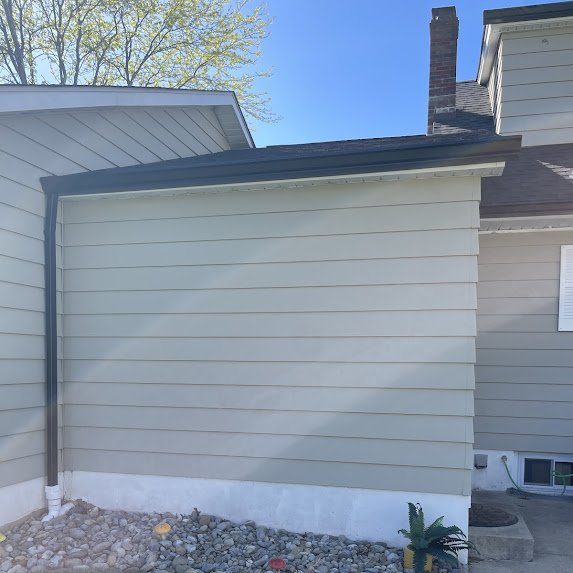
- 5-inch K-style handles most NJ homes; step up to 6-inch for large, steep, or complex roofs that shed more water.
- A 6-inch trough holds roughly 40% more water, and bigger outlets keep heavy summer downpours from blowing over the edge.
- Seamless beats sectional either way: runs are formed on-site to your exact roofline, so the only joints are at corners and outlets.
The Short Version
5-inch K-style gutters are the residential standard. They work fine on most single-story homes with moderate roof area. 6-inch K-style gutters hold about 40% more water by cross-sectional area but, more importantly, their standard 3-inch by 4-inch downspouts can move nearly four times the water volume of the 2-inch by 3-inch downspouts that come with 5-inch gutters.
For most two-story homes, homes with steep pitches, or homes with large roof areas draining to a few downspouts, 6-inch is the better choice. The cost difference at install is small. The performance difference during a real nor'easter is significant.
What the Sizes Actually Mean
Gutter "size" refers to the width measured across the opening at the top. A 5-inch K-style gutter is about 5 inches wide at the top; a 6-inch is 6 inches wide. The profile, the K-shape with the decorative front, is the same in both sizes. That's why 6-inch installs don't look clunky or out of proportion on residential homes. Visually, most people don't even notice the difference until it's pointed out.
Downspouts are where the real difference lives. Standard 5-inch gutters are paired with 2×3 downspouts (2 inches by 3 inches). Standard 6-inch gutters are paired with 3×4 downspouts. That's a cross-sectional area jump from 6 square inches to 12 square inches, exactly double. Combined with better flow dynamics in the larger pipe, the real-world water handling is close to 4× greater.
When 5-Inch Is Fine
- Single-story ranch homes with gentle roof pitches
- Roof areas under about 1,200 square feet per downspout
- Homes in areas without heavy tree cover
- Tight budgets where the difference matters and the roof is small
If you've had 5-inch gutters for years without overflow problems, replacing with 5-inch is a reasonable choice. You're getting fresh hangers, clean joints, and a like-new system without changing the fundamentals.
When to Upgrade to 6-Inch
- Two-story or three-story homes. Taller homes have more vertical drop, which means more kinetic energy in the water by the time it hits the gutter. 5-inch gutters often get overwhelmed at the junctions.
- Large roof areas with few downspouts. If you have a long roof run feeding into one or two downspouts, the 3×4 downspouts on a 6-inch system make a huge difference.
- Steep roof pitches. Steep pitches dump water fast. 6-inch gutters handle the initial slug better.
- Heavy tree canopy. More debris means partial clogs happen between cleanings. Larger gutters give you more margin before overflow starts.
- History of overflow problems. If your existing 5-inch gutters overflow in heavy rain even when clean, you've already proven they're undersized. Upgrading to 6-inch solves the problem directly.
The Cost Difference
The materials cost for 6-inch aluminum is higher than 5-inch, but not dramatically so, typically 15 to 25% more per linear foot for the gutter itself, and similar for the larger downspouts. Labor is roughly the same; the install process is identical. On a typical Central NJ home, the total difference between a 5-inch and 6-inch install often works out to a few hundred dollars, not thousands.
For a system you're going to live with for 20+ years, that's a rounding error compared to the cost of a single fascia repair caused by overflow.
What About 7-Inch or Larger?
7-inch gutters exist and have their place, mostly on commercial buildings, very large estates, or residential homes with unusual roof geometries that dump huge volumes of water into short gutter runs. For 98% of New Jersey homes, the answer is 5-inch or 6-inch. If you're in the 2% that genuinely needs larger, we'll tell you, but nobody should be upselling you to 7-inch as the default.
Seamless vs Sectional
This is orthogonal to the size decision, but worth mentioning. Seamless gutters are formed on-site from a single coil of aluminum, run to the exact length of your roof edge, with joints only at corners and end caps. Sectional gutters are 10-foot pre-made lengths joined together. Seamless means fewer leak points, a cleaner visual line, and a longer functional lifespan. We install seamless exclusively, and we'd recommend it to anyone, size is the bigger decision, but seamless is the obvious one.
Colors
Both 5-inch and 6-inch are available in all nine of our stock aluminum colors: white, black, brown, clay, gray, bronze, copper, ivory, and sandstone. Color doesn't affect performance at all, it's purely aesthetic. Most homeowners match the fascia color or the roof trim.
The Bandit's Recommendation
If it's a new install and you have the option, go 6-inch. The cost premium is small, the performance gain is real, and in a state like New Jersey with nor'easters, sudden summer storms, and a lot of tree-lined properties, the extra capacity earns its keep. The one place we'd push back: a small single-story home with short gutter runs and no overflow history, 5-inch is genuinely fine there.
We install both sizes across Freehold, Manalapan, Marlboro, and all of Central NJ. Call (908) 242-6056 for a free estimate, we'll measure, talk through the tradeoffs, and give you an honest recommendation.
Frequently Asked Questions
Are 6-inch gutters worth it in New Jersey?
For large, steep, or complex roofs, yes. A 6-inch trough holds roughly 40% more water than a 5-inch, and paired with bigger downspouts it keeps heavy NJ summer storms from blowing over the front edge. Most average-size homes are still fine on 5-inch.
How much more do 6-inch gutters cost than 5-inch?
The upgrade is modest at install time, usually a small percentage of the total job, because the labor is nearly identical. Upgrading later as a standalone project costs far more, which is why we recommend deciding size at replacement time.
Do seamless gutters really matter, or is that marketing?
They matter. Sectional store-bought gutter fails at its joints first, and a seamless run formed on-site to your exact roofline has joints only at corners and outlets. Fewer joints means fewer leaks and fewer places for debris to catch.
Can I get 6-inch gutters in colors other than white?
Yes. Colored aluminum coil runs through the same on-site roll-former as white, so you get the same seamless system in a finish matched to your trim. We install in 9 colors across Central NJ.